
This recipe doesn’t only make wonderfully soft buns for Vada Pav, it is the ultimate recipe for any soft bread bun. Indian Pavs? You’ve got it. Burger buns? Yessir. Babka? Bring it on! Whenever I bake anything that requires a soft pillowy dough, this it the recipe I use.
Usually, bread rolls are enriched with egg and dairy, giving them a soft texture and rich flavour. Using oil works incredibly well though and is an easy way to make vegan buns without any complex substitutes. I used a mild olive oil, which means that the flavour comes primarily from the flour and the fresh yeast.
You can find fresh yeast at Bakery Bits (they also sell organic yeast sachets without emulsifiers) and sometimes at Planet Organic. This should really be way more common in shops though. If you can’t get it, a sachet will do the job.
To handle doughs with high hydration, let it rest after initially mixing the dough. The flour will absorb the water and the gluten starts to build. Then use the Slap & Fold technique described below and in this video to build the gluten without the dough sticking to your hands.
serves 4 | makes 9 small buns
Ingredients
-
20g fresh yeast (or 7g dried yeast)
-
1 tsp golden granulated sugar
-
40 g olive oil
-
230 ml warm water
-
400g bread flour
-
8g salt
-
2 tbsp non-dairy milk
-
1 tbsp maple syrup
Method
Crumble the yeast into a medium-sized mixing bowl. Add the sugar, oil and water and stir with a fork to dissolve.
In a large bowl, whisk together the flour and salt, pour in the dissolved yeast and use your hands to mix everything into a rough dough. Tip out the dough onto a work surface and knead it until it becomes too sticky to handle. Then simply cover it with a bowl turned upside down and let it rest for 10 minutes. The flour will continue to absorb the water, which kickstarts the gluten development and makes it easier to handle.
After 10 minutes, it will still be too sticky to knead. Instead, we’re using a technique called Slap & Fold (watch here), which allows us to handle doughs with a higher hydration without adding more flour. That way our final buns will be extra pillowy. Start by lifting the dough, then slapping one end of it back onto the work surface. Now fold the other end (the one you’re holding) over the dough, thereby stretching it slightly and developing the gluten structure. Turn the dough by 90° and repeat. Try to do this in confident and quick movements to avoid the dough from sticking to your hands. After a few turns, you will notice the dough beginning to firm up. You can now give it a knead until it becomes too sticky again, then simply repeat the Slap & Fold. Work the dough this way for around 10 minutes, until it feels soft & pliable and less sticky to the touch. Shape it into a large ball by stretching it with both hands curbed around it towards you over the surface. It should spring back when you poke it. Grease a large bowl with oil and transfer the dough. Then cover it with a damp kitchen towel and leave it to proof and double in size for 1 hour.
Deflate the dough by punching it down a little bit, then divide it into 9 equal portions (roughly 70g – 75g per each). Grease a small baking dish (mine is 23cm x 23 cm) with oil, then shape each piece of dough into a ball by stretching it over the surface in circular movements with one hand. You really want to stretch the dough here to create a smooth surface across it. Think of it as a skin that drapes around the rest of the dough and traps the air while baking, which allows it to expand beautifully. Place the finished balls into the baking dish, cover again with the damp towel and let them double once more for 45-60 minutes.
In the meantime, preheat the oven to 220°C. Once the buns are ready, combine the non-dairy milk of your choice with the maple syrup and brush it over the buns. Then bake them for 20-25 minutes until golden brown, turning the tray 180° halfway through for even baking. Let them cool down for 30 minutes to allow them to soften before serving.
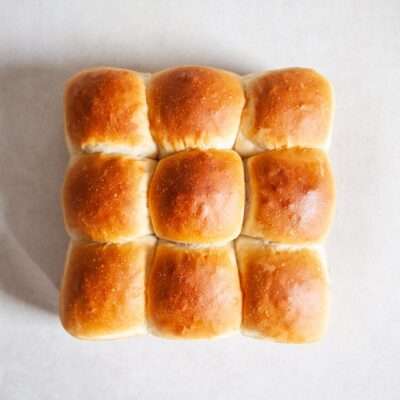
Bread Buns
Ingredients
- 20 g fresh yeast or 7g dried yeast
- 1 tsp golden granulated sugar
- 40 g olive oil
- 230 ml warm water
- 400 g bread flour
- 8 g salt
- 2 tbsp non-dairy milk
- 1 tbsp maple syrup
Instructions
- Crumble the yeast into a medium-sized mixing bowl. Add the sugar, oil and water and stir with a fork to dissolve.
- In a large bowl, whisk together the flour and salt, pour in the dissolved yeast and use your hands to mix everything into a rough dough. Tip out the dough onto a work surface and knead it until it becomes too sticky to handle. Then simply cover it with a bowl turned upside down and let it rest for 10 minutes. The flour will continue to absorb the water, which kickstarts the gluten development and makes it easier to handle.
- After the 10 minutes, it will still be too sticky to knead. Instead we’re using a technique called Slap & Fold (watch here), which allows us to handle doughs with a higher hydration without adding more flour. That way our final buns will be extra pillowy. Start by lifting up the dough, then slapping one end of it back onto the work surface. Now fold the other end (the one you’re holding) over the dough, thereby stretching it slightly and developing the gluten structure. Turn the dough by 90° and repeat. Try to do this in confident and quick movements to avoid the dough from sticking to your hands. After a few turns, you will notice the dough beginning to firm up. You can now give it a knead until it becomes too sticky again, then simply repeat the Slap & Fold. Work the dough this way for around 10 minutes, until it feels soft & pliable and less sticky to the touch. Shape it into a large ball by stretching it with both hands curbed around it towards you over the surface. It should spring back when you poke it. Grease a large bowl with oil and transfer the dough. Then cover it with a damp kitchen towel and leave to proof and double in size for 1 hour.
- Deflate the dough by punching it down a little bit, then divide it into 9 equal portions (roughly 70g - 75g per each). Grease a small baking dish (mine is 23cm x 23 cm) with oil, then shape each piece of dough into a ball by stretching it over the surface in circular movements with one hand. You really want to stretch the dough here to create a smooth surface across it. Think of it as a skin that drapes around the rest of the dough and traps the air while baking, which allows it to expand beautifully. Place the finished balls into the baking dish, cover again with the damp towel and let them double oncer more for 45-60 minutes.
- In the meantime, pre-heat the oven to 220°C. Once the buns are ready, combine the non-dairy milk of your choice with the maple syrup and brush it over the buns. Then bake them for 20-25 minutes until golden brown, turning the tray 180° halfway through for even baking. Let them cool down for 30 minutes to allow them to soften before serving.



0 Comments